The Strait of Hormuz Is Closed — Oil Is Spiking, 5 Nations Are Under Attack, and the World Is Watching
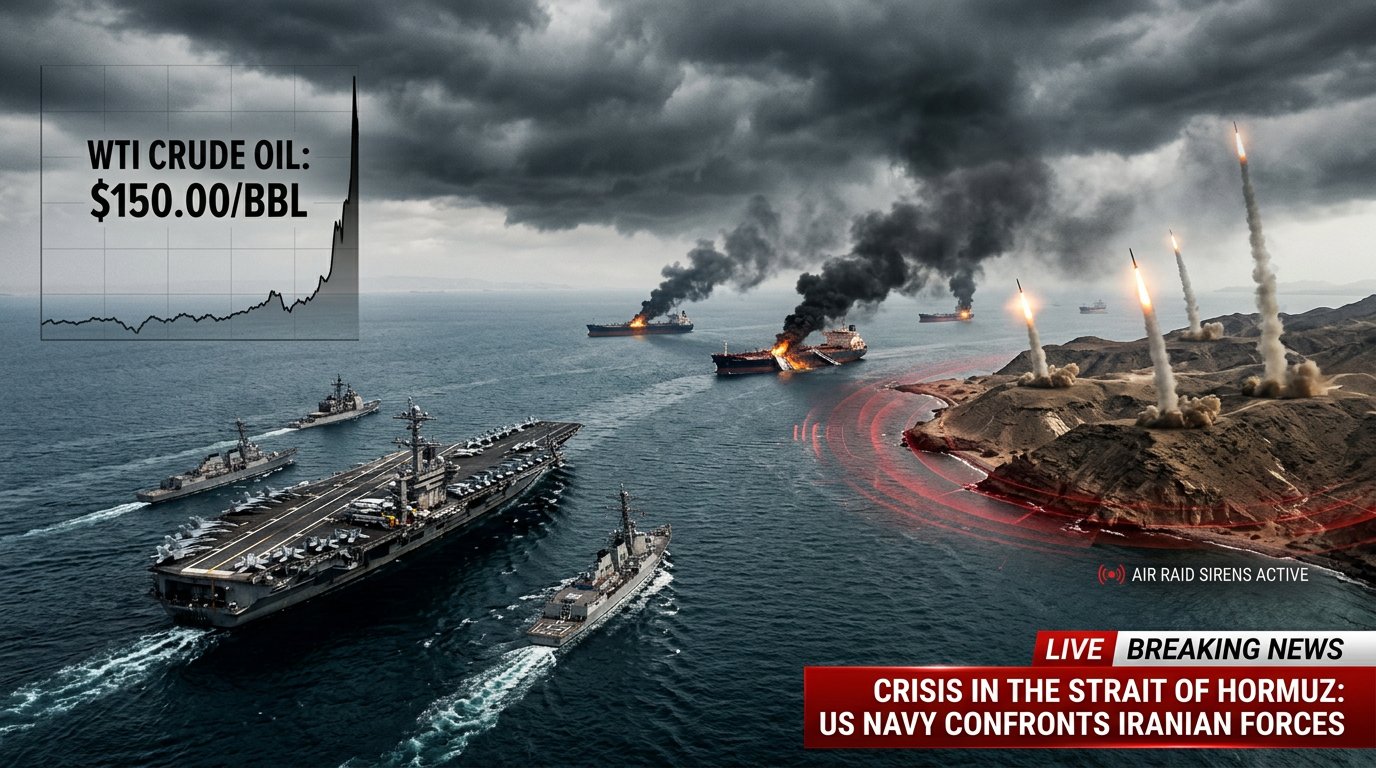
Here is something that should frighten you more than it probably does: as of this morning, the single most important waterway in the global economy is closed. Not disrupted. Not restricted. Closed.
The Strait of Hormuz — the 21-mile-wide choke point through which roughly 21 percent of the world’s petroleum consumption passes every single day — is no longer open for business. Iran’s Islamic Revolutionary Guard Corps Navy announced on Saturday that the strait “will remain closed until further notice.” It then fired on a commercial vessel that tried to transit anyway. The crew abandoned ship into a lifeboat.
The United States responded with the largest single wave of airstrikes since the opening days of the conflict in February. One hundred and forty Iranian military targets were hit in 24 hours — missile sites, drone storage facilities, ammunition depots, coastal defense batteries, communication networks. That followed two earlier rounds of strikes on Tuesday and Wednesday that hit more than 170 additional targets. The three-day total: over 300 Iranian military positions bombed.
Iran responded not by backing down but by expanding the war. In the early hours of Sunday morning, Iranian missiles and drones targeted American military assets across the Gulf. Qatar intercepted ballistic missiles. The United Arab Emirates activated its air defense systems. Kuwait engaged “hostile aerial targets” in its airspace. Bahrain’s air raid sirens wailed across the capital. Jordan reported three missiles originating from Iranian territory striking multiple locations inside the kingdom.
The war that started in February with joint US-Israeli strikes on Iranian nuclear facilities has now, in July 2026, become something larger and more dangerous than anything the region has seen since the 1973 Yom Kippur War. It is no longer a bilateral conflict between Washington and Tehran. It is a regional conflagration pulling in the entire Gulf, threatening the global oil supply, and testing the limits of American military power against an adversary that has spent two decades preparing for exactly this fight.
Why Hormuz Matters More Than Anything
Before we get to the missiles and the casualties and the geopolitical chess game, let us understand why a 21-mile strip of water between Iran and Oman is the center of gravity for the entire global economy.
The Strait of Hormuz connects the Persian Gulf to the Gulf of Oman and the Arabian Sea. Every day, approximately 20 to 21 million barrels of crude oil and petroleum products pass through it. That is roughly one-fifth of total global consumption. The biggest customers are China, Japan, South Korea, and India — the manufacturing engines of the global economy. When Hormuz closes, those engines starve.
The last time anything close to this happened was the 1973 Arab oil embargo, which quadrupled oil prices and triggered a global recession. The 1990 Iraqi invasion of Kuwait temporarily disrupted Gulf oil flows, but the strait itself remained open to shipping from Saudi Arabia, the UAE, and other producers on the Arabian side.
This is different. Iran physically controls the eastern side of the strait. Its coastline dominates the narrowest section of the waterway. From that coastline, it can deploy anti-ship missiles, naval mines, fast attack craft, and drone swarms that can deny passage to any vessel regardless of flag or ownership. The US Navy’s Fifth Fleet, based in Bahrain and operating from the USS Abraham Lincoln carrier strike group in the Arabian Sea, has the theoretical capability to force the strait open. But doing so would require suppressing Iran’s entire coastal defense network — missile batteries, radar installations, command centers, naval bases — while simultaneously providing security for individual commercial vessels transiting the most heavily contested waterway on Earth.
This is not a theoretical exercise. The cost of failure is oil at $200 a barrel. Global recession. Food shortages in import-dependent nations. Political instability cascading through economies that are barely holding on as it is.
What Actually Happened This Week
The ceasefire between the United States and Iran, negotiated through Omani mediators and formalized in a memorandum of understanding signed in June, was fragile from the start. Its central provision was that Iran would guarantee safe passage for commercial shipping through the Strait of Hormuz in exchange for the United States lifting secondary sanctions on Iranian oil exports.
Both sides tested the agreement’s limits. Iran began accelerating exports from Kharg Island, its main oil terminal, shipping out an estimated 10 million barrels of crude and fuel oil in a single night. The United States revoked a sanctions waiver that had been part of the arrangement, re-imposing penalties on any foreign entity that touched Iranian crude.
By Wednesday, July 8, Iran’s Revolutionary Guard Corps Navy had determined that several commercial vessels were using “unapproved” routes through the strait — routes that did not pass through Iranian territorial waters. The IRGC Navy issued warnings. The warnings were ignored. The IRGC Navy attacked.
Three ships were struck by drones on Wednesday and Thursday. One, a Saudi-flagged oil tanker, sustained significant damage but remained afloat. Another, a Qatari vessel carrying liquefied natural gas, was forced to divert to Omani waters. The third, a container ship, was “halted” by what the IRGC described as a “warning shot” — and then abandoned by its crew on Friday after sustaining a direct hit.
The United States launched its first retaliatory strikes on Tuesday, hitting approximately 80 targets. A second wave on Wednesday struck an additional 90. A third wave on Saturday — the largest single barrage since the opening of the war — hit 140 more. The targets were concentrated in Iran’s southern coastal provinces, particularly around the port cities of Bandar Abbas, Bushehr, and Chabahar, where much of Iran’s naval and missile infrastructure is located.
Iran’s response came not against US Navy vessels — which are heavily defended — but against American bases and allied nations in the Gulf. This is a deliberate strategy: escalate horizontally, not vertically. Force Washington to defend five or six different fronts simultaneously. Make the cost of continued operations politically unsustainable for America’s Gulf allies. Demonstrate that bombing Iran will not make the region safer for anyone.
The Human Toll
Iran’s health ministry reports that 14 people have been killed and 78 wounded in the latest round of US strikes. Civilian infrastructure has been hit — railway lines connecting Tehran to the northeast, bridges, power substations. Videos verified by the New York Times show damage to a railway bridge near the city of Agh Qala. The Iranian government says US forces also struck a railway line near the Caspian coast, hundreds of miles from the nearest military target in the south.
Whether these were deliberate strikes on dual-use infrastructure or targeting errors is unclear. What is clear is that the war is no longer confined to military installations. It is reaching into the Iranian interior. It is disrupting transportation networks that have nothing to do with naval warfare. It is killing civilians.
The crew of the abandoned container ship were rescued by the Omani coast guard. Their vessel remains adrift in the strait, a hazard to navigation and a symbol of the paralysis that has gripped one of the world’s most vital economic arteries.
In Qatar, three people were injured by falling debris when air defense systems intercepted incoming missiles. In Jordan, the government reported “minor material damage” from three missiles that fell early Sunday morning. Across the Gulf, millions of people spent Saturday night listening to air raid sirens and wondering whether the next missile would get through.
The Oil Markets Are Screaming
Brent crude futures opened at $148 a barrel on Friday — up from $82 before the February conflict began. Some analysts are projecting $200 by the end of July if the strait remains closed and Iranian production continues to be disrupted by strikes. Goldman Sachs issued a client note on Thursday warning that a “sustained Hormuz closure combined with full disruption of Iranian exports would remove approximately 20 million barrels per day from global supply,” which would constitute “the largest supply shock since the 1979 Iranian Revolution.”
The 1979 supply shock triggered a global recession. The 2026 shock, if it materializes, would hit an economy already battered by years of post-pandemic inflation, trade fragmentation, and the economic drag of AI-driven labor displacement across multiple sectors.
China, which imports roughly 40 percent of its oil through Hormuz, faces a particularly acute crisis. Beijing has been largely silent on the conflict — a silence that reflects its impossible position between its energy security imperative and its strategic partnership with Iran. But that silence cannot hold. If Hormuz stays closed, China will have to choose between accepting the economic consequences of energy starvation and intervening in a conflict it has spent months trying to avoid.
Trump Says Iran Wants a Deal. Iran Says the Era of One-Sided Deals Is Over.
Speaking to reporters aboard Air Force One on Thursday, President Trump claimed that Iranian leaders had “called a little while ago” and “want a deal so badly.” He provided no evidence for the claim, and there is no independent confirmation that any such communication occurred.
On Sunday, the speaker of the Iranian parliament, Mohammad Bagher Ghalibaf — who has served as Tehran’s chief negotiator in peace talks — posted a response on X that was less a diplomatic overture than a declaration of defiance.
“The era of one-sided deals is OVER,” Ghalibaf wrote. “We told you: keep your word or pay the price. Reality is knocking.”
The post included a screenshot of the June memorandum of understanding in which Iran committed to securing safe passage for commercial shipping. The implication was clear: from Tehran’s perspective, the United States broke the deal first by revoking sanctions waivers and resuming strikes. Iran’s closure of the strait is not aggression. It is consequences.
This framing may or may not be accurate, but it is effective. It allows Iran to present itself as the wronged party defending its sovereign rights against foreign interference. It also makes any diplomatic resolution more difficult, because Iran’s minimum ask — full restoration of the ceasefire terms, including sanctions relief — now looks like rewarding the very behavior that triggered the latest escalation.
What Happens Next: Three Scenarios
The path forward depends on variables that are shifting by the hour. Three broad scenarios are emerging among analysts and military planners.
Scenario 1: De-escalation through exhaustion. Both sides have now demonstrated their capacity to inflict damage. The United States has shown it can strike Iranian targets with impunity. Iran has shown it can close Hormuz and strike US allies across the Gulf. Neither side has achieved a decisive advantage. At some point, the costs of continued escalation — $150 oil, mounting casualties, the risk of a broader regional war — may force both parties back to the negotiating table. This is the most likely outcome, but there is no indication it will happen soon.
Scenario 2: Horizontal escalation. Iran continues its strategy of striking US allies across the Gulf while avoiding direct confrontation with US naval forces. Qatar, the UAE, Bahrain, Kuwait, and Jordan begin pressuring Washington to de-escalate because their territory is becoming the battleground. The coalition of Gulf states that has quietly supported US operations begins to fracture. If one or more Gulf states demands that American forces leave their territory to avoid further attacks, the US military position in the region becomes untenable.
Scenario 3: Full-scale confrontation. The US Navy attempts to forcibly reopen the Strait of Hormuz by conducting a minesweeping and escort operation while simultaneously suppressing Iranian coastal defenses. This would be the largest naval operation since World War II. It would involve the USS Abraham Lincoln carrier strike group, multiple destroyer squadrons, submarine assets, and land-based air power from bases across the Gulf. Iran would respond with its full arsenal of anti-ship missiles, mines, drone swarms, and small-boat attacks. The outcome would be uncertain. The cost would be enormous. And even if the US Navy succeeded in forcing the strait open, Iran could simply close it again by mining the approaches or firing on transiting vessels from mobile launchers hidden along its coastline.
The Bigger Picture
The Strait of Hormuz crisis is not happening in isolation. It is intertwined with the broader deterioration of US-Iran relations that began with the US withdrawal from the JCPOA nuclear deal in 2018, accelerated through years of shadow warfare and proxy conflicts, and exploded into open hostilities in February 2026. It is connected to the US-Israel strikes on Iranian nuclear facilities. To the assassination of Iranian nuclear scientists. To the IRGC’s support for Hezbollah, the Houthis, and Shia militias across the Middle East. To Iran’s accelerating nuclear program, which may now be months rather than years away from weaponization.
It is also connected to the global economic order that depends, fundamentally, on the free flow of oil through a handful of maritime chokepoints that are vulnerable to exactly the kind of asymmetric warfare Iran has perfected. Hormuz is the most important of these chokepoints, but not the only one. The Strait of Malacca, the Suez Canal, the Bab el-Mandeb, the Turkish Straits — each is a single point of failure in a global system that has no redundancy. The lesson of Hormuz is that an adversary with enough anti-ship missiles, enough drones, and enough willingness to absorb punishment can hold the global economy hostage.
That lesson will not be lost on other nations watching this crisis unfold.
Frequently Asked Questions
Why is the Strait of Hormuz so important?
The Strait of Hormuz is a narrow waterway between Iran and Oman that serves as the only maritime passage from the Persian Gulf to the open ocean. Approximately 20-21 million barrels of crude oil and petroleum products pass through it daily — roughly 21 percent of global petroleum consumption. The economies of China, Japan, South Korea, and India are particularly dependent on Hormuz oil flows. There is no alternative route. If the strait closes, there is no way to move oil from Saudi Arabia, Iraq, Kuwait, the UAE, or Iran to global markets except through pipelines that have limited capacity and take years to build. Prolonged closure would trigger a global energy crisis and almost certainly a global recession.
Why did Iran close the Strait of Hormuz?
Iran’s Islamic Revolutionary Guard Corps Navy announced the closure after the United States revoked a sanctions waiver that had been part of a June 2026 ceasefire agreement. The waiver had allowed Iranian crude exports to resume. When Washington re-imposed sanctions, Tehran responded by attacking commercial vessels that were transiting the strait on routes Iran considers “unapproved” — specifically, routes that do not pass through Iranian territorial waters. After warning shots and drone attacks on three vessels, Iran declared the strait closed “until further notice.” Iran frames this as a defensive response to US violations of the ceasefire; the US frames it as Iranian aggression against international shipping.
How many US strikes have hit Iran?
Over three days of operations — Tuesday, Wednesday, and Saturday of this week — the US military has struck more than 300 Iranian targets. The targets include air defense systems, missile and drone storage sites, ammunition depots, coastal defense batteries, military speed boat facilities, logistics infrastructure, and communication networks. The strikes have been concentrated in Iran’s southern coastal provinces, particularly around Bandar Abbas, Bushehr, and Chabahar. This is the most intense bombing campaign against Iran since the opening days of the conflict in February 2026, when joint US-Israeli strikes hit Iranian nuclear facilities.
Which countries are under attack right now?
As of Sunday, July 12, five Middle Eastern nations have reported attacks related to the Iran-US escalation: Qatar intercepted ballistic missile attacks (three people injured by falling debris), the United Arab Emirates activated air defense systems against incoming missiles and drones, Kuwait’s army engaged “hostile aerial targets” within its airspace, Bahrain’s air raid sirens were activated with official warnings of incoming threats, and Jordan reported three missiles “originating from Iranian territory” striking multiple locations inside the kingdom (no casualties, minor material damage). These attacks represent a deliberate Iranian strategy of horizontal escalation — striking US allies rather than directly confronting US military forces.
What is happening to oil prices?
Brent crude futures reached $148 per barrel on Friday, up from approximately $82 before the conflict began in February 2026. Some analysts project $200 per barrel by the end of July if the strait remains closed. Goldman Sachs has warned that a sustained Hormuz closure combined with full Iranian export disruption would remove approximately 20 million barrels per day from global supply — the largest supply shock since the 1979 Iranian Revolution, which triggered a global recession. Gasoline prices in the United States have risen to a national average of $5.80 per gallon, with some states exceeding $7. In Europe and Asia, the impact is even more severe due to higher import dependence.
Does Iran really want a deal, as Trump claims?
There is no independent evidence confirming President Trump’s claim that Iranian leaders contacted him seeking a deal. The speaker of Iran’s parliament, Mohammad Bagher Ghalibaf, publicly rejected the suggestion, posting on X that “the era of one-sided deals is OVER.” Iran’s public position is that the US violated the June ceasefire by revoking sanctions waivers and resuming military strikes, and that any future agreement must include credible enforcement mechanisms. Analysts note that both sides have incentives to de-escalate — Iran’s economy cannot sustain a prolonged war, and the US cannot allow Hormuz to remain closed — but the trust required for meaningful negotiations has been severely damaged by the latest round of violence.
Could this trigger a global recession?
If the Strait of Hormuz remains closed for an extended period — weeks to months — the economic impact would almost certainly trigger a global recession. The 1973 Arab oil embargo, which removed roughly 5 million barrels per day from global markets, caused oil prices to quadruple and triggered a severe recession in oil-importing nations. The current disruption is potentially larger: up to 20 million barrels per day of Persian Gulf production could be affected. The global economy in 2026 is also more vulnerable than in 1973, still recovering from post-pandemic inflation, trade fragmentation, and the economic disruption of AI-driven labor displacement. Central banks have limited room to cut interest rates because inflation — partly driven by energy prices — remains above target in most major economies.
Disclaimer
This article is based on publicly available news reports, official statements from the US Central Command, the Islamic Revolutionary Guard Corps, national defense ministries of Qatar, the UAE, Kuwait, Bahrain, and Jordan, verified video footage, and analysis from the New York Times, ABC News, CNN, Sky News, Goldman Sachs, and maritime tracking services as of July 12, 2026. Military operational details are based on official statements and may be incomplete or subject to revision. Oil price figures are based on intraday trading data and are subject to market volatility. This article is for informational purposes only and does not constitute investment advice, political analysis, or military assessment. Readers should consult official government sources for emergency information and qualified financial professionals for investment decisions.
Published: July 12, 2026 | Last Updated: July 12, 2026
Sources: US Central Command, IRGC Navy statements via Tasnim News, Qatar Ministry of Interior, UAE Ministry of Defense, Kuwait Army General Staff, Jordanian government, Bahrain Ministry of Interior, ABC News, CNN, The New York Times, Sky News, Goldman Sachs Global Research, MarineTraffic, TankerTrackers, Windward maritime intelligence, IFAB Laws of the Game 2025-26.